  OPENAI_API_KEY="$(llm keys get openai)" \
    uv run https://tools.simonwillison.net/python/openai_image.py \
    -m gpt-image-2 \
    "Do a where's Waldo style image but it's where is the raccoon holding a ham radio"
Here's what I got from that prompt. I do not think it included a raccoon holding a ham radio (though the problem with Where's Waldo tests is that I don't have the patience to solve them for sure): https://gist.github.com/simonw/88eecc65698a725d8a9c1c918478a...
  OPENAI_API_KEY="$(llm keys get openai)" \
    uv run 'https://raw.githubusercontent.com/simonw/tools/refs/heads/main/python/openai_image.py' \
    -m gpt-image-2 \
    "Do a where's Waldo style image but it's where is the raccoon holding a ham radio" \
    --quality high --size 3840x2160
Fed into a clear Claude Code max effort session with : "Inspect waldo2.png, and give me the pixel location of a raccoon holding a ham radio.". It sliced the image into small sections and gave:
"Found the raccoon holding a ham radio in waldo2.png (3840×2160).
  - Raccoon center: roughly (460, 1680)
  - Ham radio (walkie-talkie) center: roughly (505, 1650) — antenna tip around (510, 1585)
  - Bounding box (raccoon + radio): approx x: 370–540, y: 1550–1780

  It's in the lower-left area of the image, just right of the red-and-white striped souvenir umbrella, wearing a green vest. "
We would need a larger sample size than just myself, but the raccoon was in the very first spot I looked. Found it literally immediately, as if that's where my eyes naturally gravitated to first. Hopefully that's just luck and not an indictment of the image-creating ability, as if there is some element missing from this "Where's Waldo" image, that would normally make Waldo hard to find.
Finding the raccoon was instant. Finding all the weird AI artifacts is more fun. It's quite fascinating really. As usual it looks impressive at a glance but completely falls apart on closer inspection. I also didn't find any jokes, unless maybe the bridge to nowhere or finger posts pointing both ways counts?
p.s. aaaand that's soft launch my SaaS above, you can replace wojak.jpg with anything you want and it will paint that. It's basically appending to prompt defined by elsrc's dashboard. Hopefully a more sane way to manage genai content. Be gentle to my server, hn!
are you using the same prompt the above commenter used? I've been toying around with increasingly ridiculous prompts and it works surprisingly well. It's the new ChatGPT image gen or Nano Banana?
Kinda made me sad assuming the author didn't license anything to OpenAI.
I recognize it could revert (99% of?) progress if all the labs moved to consent-based training sets exclusively, but I can't think of any other fair way.
$.40 does not represent the appropriate value to me considering the desirability of the IP and its earning potential in print and elsewhere. If the world has to wait until it’s fair, what of value will be lost? (I suppose this is where the big wrinkle of foreign open weight models comes in.)
License what? The concept of a hidden object search? The only stylistic similarity here is the viewing angle. Where’s Waldo comics are flat, brightly colored line drawings that look nothing like this at all.
Well, I recognized the style from even the new physical books on sale today, but I don’t know art well enough to use a term like flat.
I am not an art expert but I’m perhaps a reasonable consumer and there is possibility of confusion if someone sells AI Where’s Waldo knockoff books at the dollar store, maybe until I take a closer look.
There have already been several attempts to procedurally generate Where’s Waldo? style images since the early Stable Diffusion days, including experiments that used a YOLO filter on each face and then processed them with ADetailer.
It's a difficult test for genai to pass. As I mentioned in a different thread, it requires a holistic understanding (in that there can only be one Waldo Highlander style), while also holding up to scrutiny when you examine any individual, ordinary figure.
I've actually been feeding them into Claude Opus 4.7 with its new high resolution image inputs, with mixed results - in one case there was no raccoon but it was SURE there was and told me it was definitely there but it couldn't find it.
Like... this has things that AI will seemingly always be terrible at?
At some point the level of detail is utter garbo and always will be. An artist who was thoughtful could have some mistakes but someone who put that much time into a drawing wouldn't have:
- Nightmarish screaming faces on most people
- A sign that points seemingly both directions, or the incorrect one for a lake and a first AID tent that doesn't exist
- A dog in bottom left and near lake which looks like some sort of fuzzy monstrosity...
It looks SO impressive before you try to take in any detail. The hand selected images for the preview have the same shit. The view of musculature has a sternocleidomastoid with no clavicle attachment. The periodic table seems good until you take a look at the metals...
We're reconfiguring all of our RAM & GPUs and wasting so much water and electricity for crappier where's Waldos??
No, it won't be. I did indeed get the same problems when trying to generate my own image for it.
However as someone who's mucked about with local image generation as well - I'd say that this is a problem with their implementation, it doesn't resolve fine detail because majority of requests it won't matter/it drastically increases compute requirements.
With local image generation bad features/incorrect fingers/disfigurement etc has been solved for a long time.
I think their new process involves multiple steps including sketching/fleshing out the idea before adding detail. The step that would fix this would be outpainting or similar to tile based upscaling.
From what I understand of image generation models they also struggle with fine detail in general because they aren't really trained for that. However for each tiny chunk of a detailed image like that there's nothing to say they can't allocate a 500x500 chunk for it to work in as its "idea/reference space" and then transpose that into the main image being generated - i.e. generate image features separately rather than all together.
Really hard to look at these images given how not human like the humans are. A few are ok, but a lot are disfigured or missing parts and its hard to find a raccoon in here.
This happens all too frequently when you ask a GenAI model to create an image with a large crowd especially a “Where’s Waldo?” style scenes, where by definition you’re going to be examining individual faces very closely.
Yes, it’s not there yet. But nothing unsolvable. First thing that comes to mind would be generating smaller portion at the same resolution, then expand through tiling (although one might need to use another service & model for this), like we used to do with Stable Diffusion years ago.
Another option would be generating these large images, splitting them into grids, and using inpainting on each "tile" to improve the details. Basically the reverse of the first one.
Both significantly increase costs, but for the second one having what Images 2.0 can produce as an input could help significantly improve the overall coherence.
5.4 thinking says "Just right of center, immediately to the right of the HAM RADIO shack. Look on the dirt path there: the raccoon is the small gray figure partly hidden behind the woman in the red-and-yellow shirt, a little above the man in the green hat. Roughly 57% from the left, 48% from the top."
Oh god yes, I've been trying to make a LLM Assisted Magic the Gathering card scanner... its been a hell of a time trying to get it to just OCR card names well....
Yep, Its pretty damn good compared to classic OCR and even more lightweight ones as well that I can run locally. the cards just vary too much over time.


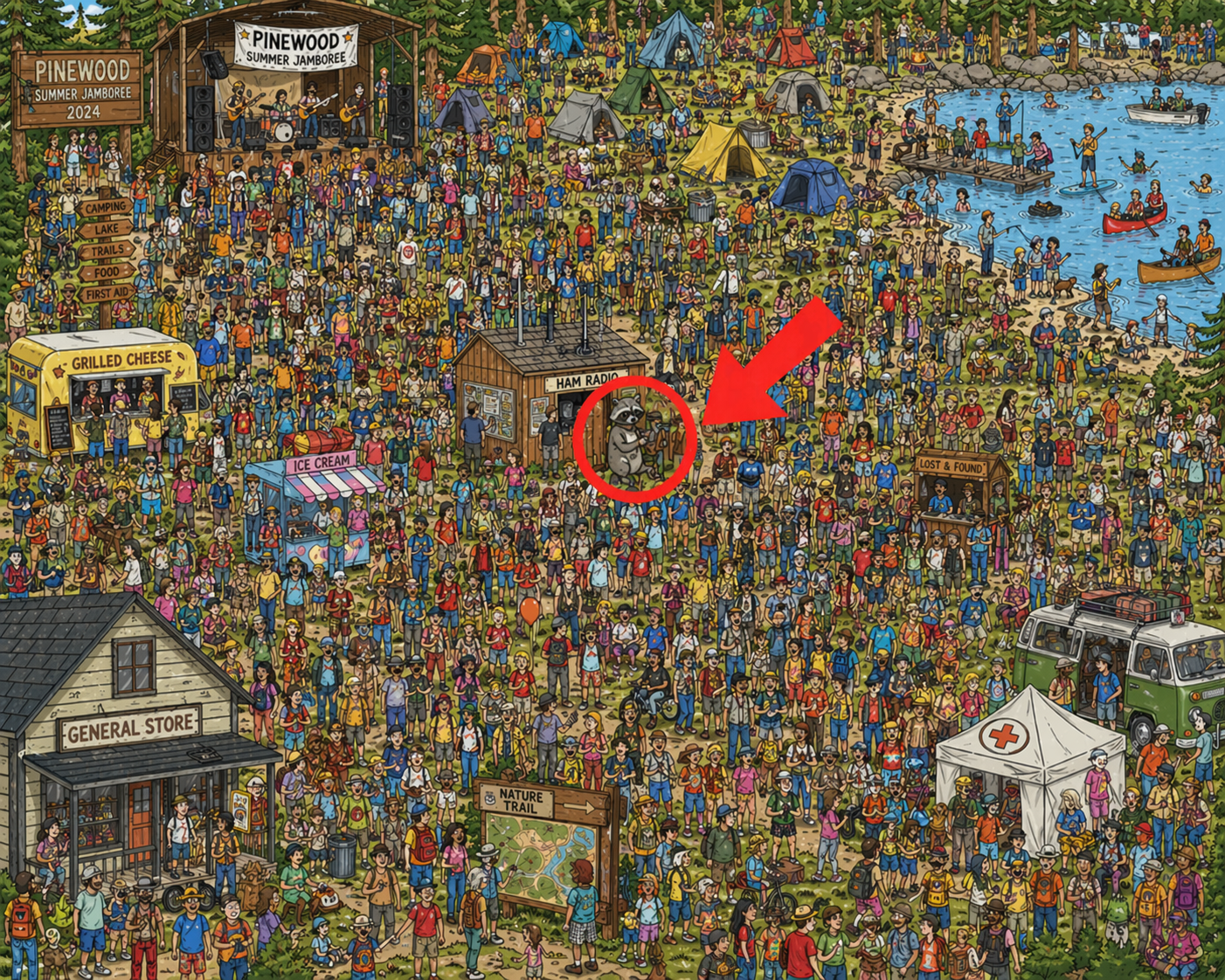
Here's what I got from that prompt. I do not think it included a raccoon holding a ham radio (though the problem with Where's Waldo tests is that I don't have the patience to solve them for sure): https://gist.github.com/simonw/88eecc65698a725d8a9c1c918478a...