Some pollutants do have a cooling effect and there are circumstances where purposefully increasing those pollutants could be worth it, but only if we can be sure it is temporary.
The nightmare scenario would be something like we start releasing sulfates into the upper atmosphere to induce cooling to counter the warming from greenhouse gases but do not reduce the growth in greenhouse gases.
Greenhouse gases would continue growing and so the amount of sulfates we have to release to counter that also would keep growing.
There are two big problems with that.
#1. The greenhouse gas emissions are a side effect of numerous useful and important activities. People make a lot of money from those activities. They happen unless we make a concerted effort to reduce them.
The sulfite emissions on the other hand would be specifically to counter the effects of greenhouse gases. Whoever is paying for them would be losing money doing this. All it takes is an economic downturn to make budgets tight and funding might go away.
#2. Greenhouse gases can affect climate for a long time. It takes hundreds to thousands of years in the case of CO2 for today's emissions to be no longer affecting the climate.
Sulfates in the upper atmosphere clear out in months to maybe a couple years.
Let's say then we go down the sulfates path, don't reduce greenhouse gas growth and this goes on for decades. Then something stops or disrupts the sulfate releases for a couple years and the sulfites leave the upper atmosphere.
The greenhouse gases are there still there and we rapidly get most of the warming that had been held off for decades by the sulfates.
This would likely be disastrous. Getting all that warming spread over several decades at least gives people time to adapt. Getting it all over a few years would be way to fast for people to deal with.
I think probably the only way purposefully emitting pollutants like this might be acceptable would be after we've got greenhouse gas emissions under control and are on a path we are sure is going to get is to net zero in some specific timeframe, but it will still take a few years to reach peak greenhouse emissions and we've identified a tipping point that we will hit before that. Then maybe countering that with emitting pollutants just until greenhouse gases peak and then come down to where we are below that tipping point might be reasonable.
Pollution was masking some global warming, which is worse than had been thought. This pollution cannot mask it forever, since CO2 accumulates while it does not.
There was a period during covid where cross atlantic shipping slowed, and the reduced sulfur in the air caused some increased warming. Basically things are a lot worse than we assume but there's certain accidental keystones holding things back, like pollution combating the global warming by blocking the sun.
That seems like a cynical though broadly accurate description of carbon pricing, which are in place around the world and shown to be one of the more effective interventions.
They are technically also paying the rich (and crucially the companies that supply things for both the rich and poor) to not use oil and gas too.
If you mean across borders, than the EU CBAM is already driving the installation of renewables in countries outside the EU in advance of being priced next year.
That's because India has to. Domestic demands are huge and India's coal isn't very high in quality. Not to mention coal power is largely state-controlled and doesn't allow for much private frolicking.
It's quite the opposite situation than the US, where coal is extremely high-quality and private player participation is unrestricted.
Almost all new energy construction is non-coal. Coal has collapsed even here in the US, and the current administration is unlikely to seriously change the trajectory. Gas is increasing, but mostly here in the US, but production is dropping again.
It's a transition, not a reduction. Human energy usage is going up.
It's just shifting, what types and where, energy is generated.
And those shifts, have tradeoffs.
Want cleaner air in developed urban areas via EVs? ok cool, but the tradeoff is more mines elsewhere to supply those minerals, more batteries and metals for charging infrastructure.
There is no free lunch in the energy world, solar and wind have tradeoffs.
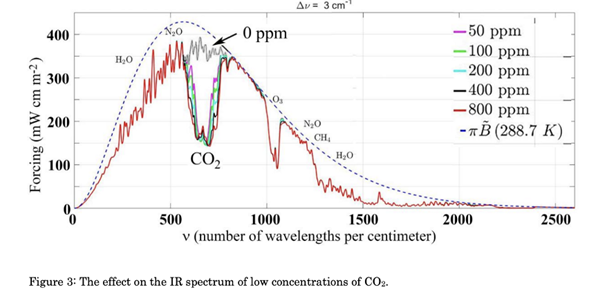
Or we should start reading books about atmosphere physics. Taking a look at the infrared spectrum and checking out what's really going on there is worth it...
"In 2021 the CO2 Coalition submitted a public comment opposing climate change disclosure rules by the U.S. Securities and Exchange Commission. The Coalition asserted "There is no 'climate crisis' and there is no evidence that there will be one," and further "Carbon dioxide, the gas purported to be the cause of catastrophic warming, is not toxic and does no harm." Both assertions are at odds with the scientific consensus on climate change."
The spectrum still is like it is. Even Cancel culture won't change it. Please read some papers about the subject... I was pretty shocked to see what kind of quality you find there... (Nothing but a little bit of quibbling, and also a lot of name calling...). There is a reason why politics shuts down some institutions... Mainly those that have some kind of consensus, that doesn't have any foundation in physics. It's just a sect... Strong believes - and no science...
Low PPM CO2 concentrations in the atmosphere affects IR in the atmosphere much as thin steel plate affects a bullet fired 5,000 yards through air .. it absorbs and scatters despite being a 'mere' PPM.
The real world physics of doubling a low CO2 concentration in representative air samples has been performed many a time .. it works as the cited paper says .. trapping more of heat energy radiated upwards by the land and sea that would otherwise diffuse outwards.
1967 is pretty ancient... Nowadays there are databases and there are detailed calculations about the spectrum (line by line). There is HITRAN database. And people did the calculations. And have done so for years... There are pretty precise calculations how much energy is being trapped. And they fit with observations. There is a saturation effect, and it's pretty strong. On each frequency you can only absorb the total amount of energy that is available there. After that adding more CO2 won't make a difference.
People calculated precisely what exactly happens when you double CO2... And the effect it's logarithmic...
FWiW you appear to basing your take on a reading pushed by Dr. C.A. de Lange of CO2Coalition of an unaccepted paper by William. A. van Wijngaarden and William Happer.
That discussion on Stackexchange has something like 6 upvotes. And if you read it, the comments there are mostly ridiculous. The absorption is logarithmic beyond 8000 ppm, and someone there e.g. whines about that Wijngaarden doesn't explain the climate on Venus (> 90% CO2 atmosphere).
The thing about Venus is also something you'll find if you look for serious papers trying to criticise the paper. Nitpicking about the word logarithmic seems to be the only things that serious critics have found. The other main argument seems to be name calling and Cancel Culture... and that's all what critics so far have produced...
Claiming that things are unaccepted is also some kind of rumour. There are more papers, and if you read them you'll notice that they're of very high quality. Just compare the quality with that of papers of critics...
To me the most compelling argument for Wijngaarden is the incredible low quality of all the writings from people from climate-institutes that tried to find something against him. OMG...
First you claim to want science, now you're saying thermodynamics goes stale?
Maybe read the paper and those that followed, especially about the follow on increases in water vapor and methane and where trapped heat energy goes once there's little to no ice left to melt and act as a sink.
The people you are quoting are a known fossil fuel disinformation crew providing a pension plan to fossils like Clauser who have zero peer review papers in any part of the climate or geophysics field despite some sound work in unrelated fields contemporous with 1967.
if you say "less humans", surely you mean "less ultra-rich humans", right? because poorer humans usually account for the minority of all the pollution.
The ultra rich can afford EVs, and well insulated homes with solar panels.
Dirt poor people heat and cook with coal or firewood. They burn down forests to plant food. They are sustained by long supply chains by well intentioned NGOs rather than local produce.
It's not simple to say rich people are polluters, and poor people are living naturally.
Although per capita, the middle class consumer may be the worst of them all.
Environmental impact of creating the EVs and giant homes with solar panels. Plus all that jet travel. You have to account for all of that, and then almost certainly they are polluting way more than middle class or poor person.
If that isn’t cynicism, here’s some optimisation thoughts:
- start with the humans that pollute more - which is way more correlated to their consumption that their solar roof surface. Sorry USA, you go first. Others high standard living countries follows.
- Regarding the cows, they have a shorter lifespan and don’t shop much neither do they heat their house or shower water. We could just stop breeding new ones and keep the existant till their death.
The cows also don't really pump up oil.
They participate in a carbon cycle.
Their farts are not a long term issue like so damn many people make it out to be. (and I don't think they don't produce (that much) more than the wildlife and plant rot they replace over the total outsized amount of space they actually take up)
If there's a reason to have less it's because we chop down forests for more grazing space to grow the herd. Environment impact aside these are carbon sinks even if vastly less efficient than kelp forests or bogs or the like.
Also because we use a bit of fossil fuels for fertilizers in part for their feed.
That said the manure they produce is probably invaluable in avoiding famines if we're going to stop utilizing Haber–Bosch or start utilizing more expensive methods without gas.
I mean if you explode all of our nuclear bombs, we’ll probably take the earth to a winter. And it’ll still be livable, just a bit more cancer all around.
Nuclear winter is extremely unlikely to be survivable for most humans. With enough sediment in the atmosphere the earth will cool AND most crops will fail, causing world-wide famines.