>Probably 80% of the recent PhD grads I know are looking to leave academia, despite the fact that they went into it to pursue a career in academia.
Sad if true, they should have known that was a long shot, it's extremely well known that the number of postdoc and tenure track openings in any given year is far exceeded by the number of PhD grads each year.
>I think the rest of us should rest easy knowing that LLM's can't (and maybe were never meant to) tackle the tacit-knowledge-filled, human-system-centric, ambiguously-defined-problem-space jobs most mortals work.
A Statement all but guaranteed to look incredibly short sighted by 2030.
The past few years has seen a great rise in casuals reminding us of AIs limitations only to be proven wrong in 6 months. I don't think we're close to AGI, but in 2 years I've gone from AI doubter to AI convert. It's not perfect, but I don't need it to be.
The real question to me is if the system can pay for itself. Economics are racing against efficiency gains and it's anyone's guess which wins.
what are those limitations we're talking about? seems most of those the original limitations that people complained about were resolved through workarounds like tools and skills which are more software-engineering than llm advancement.
The biggest limitation I see right now is weak “theory of mind”. It’s why even though AI can generate very decent exposition, it sucks at generating narrative. This also reflects in weak performance at humor, art, and even shows up in exposition (resulting in reactions akin to “cool story bro, but why should I care?”)
It’s why people can identify AI writing even if it doesn’t contain any LLMisms. AI’s generate text that almost looks like a human wrote it, but that no human would ever actually write - when we try to imagine what kind of person would have wrote this, we draw a blank - no one we’ve ever met would have written it like that - not even any archetype we’ve ever built an internal model for.
Its kind of shocking after having an infant myself and hearing from his grandparents how little my wife and I's fathers did. One never changed a diaper and has never cooked dinner and the other looked like he had never held a baby in his life despite having 3 kids. I can't imagine not being incredibly hands on and involved.
There’s often been a “kids are mom’s until they’re dad’s” thing going on - dads do whatever with babies and younger children but the older children get heavily involved.
Of course, 50+ years ago diaper changing was often skilled labor (as was cooking) - it’s much easier to change a modern diaper and cook a modern ready-to-make meal.
It is just as easy to cook a meal from fresh ingredients. What exactly do you classify as "ready-to-make"?
I am incredibly allergic to the U.S.-American understanding of cooking as this unfathomably difficult task. No wonder there's an obesity crisis across the pond. The worst thing is, this unhealthy relationship to food seems to be exported all across the world these days.
>I've felt this way for a long time, but for the past month I've kept a journal where I put an "X" next to every date where a GitHub outage has negatively impacted my ability to work2. Almost every day has an X.
I must be a filthy casual because I'm sure I can count on one hand the number of times a Github outage has affected my work.
>I acknowledge not everyone has the privilege to spend $99 on a pair of jeans, but if you find yourself able, I think it's worthy to support American manufacturing.
I feel like I'm in a parallel universe. What year is it? Base Levis are more than that... We're also on a site filled with well off tech workers. $99 jeans aren't exactly a luxury.
Man, I have no idea what is going on here, but your link takes me to a page for 501's for $110, yet just clicking around I found this page [0] that lists what to me looks like exactly the same jeans for $85 and with an option to "Buy 2+, For $55 Each". I'm still moderately convinced that $99 is ~double the actual market rate for a pair of Levi's and even Levi's are upper middle-end in my mind. Wranglers don't look as good but they're just has hard wearing and cheaper in my experience. (For what it's worth I've worn everything from $25 Wranglers to $300 selvedge denim and my conclusion is that ~$50 Levi's are sweet spot of price/comfort/looks)
The contrast of your two perspectives kind of illustrates the information void (of quality vs price) in the article.
At Walmart it's common to get jeans (including Levi jeans) for < $20. But how long will they last? I honestly don't know, and even more I don't know how to definitely pay more for better quality.
Yeah I get that but it's not as though we're on a forum for foodstamps recipients. The median income on HN is no doubt top 10% in the nation and often far higher. Talking about $99 jeans as some great luxury is literally from a different universe.
So long as I'm fortunate enough to be able to clothe and feed my family, I'm not giving Walmart -- probably the most destructive company of all time -- any of my dollars and I don't care how cheap the shit is there.
>I just got a few pairs of shoes from AllBirds because while the name will live on I have no doubt the quality will become pretty generic now that it's no longer a Silicon Valley must-have thing.
Didn't get the memo? They're an AI infra company now ><
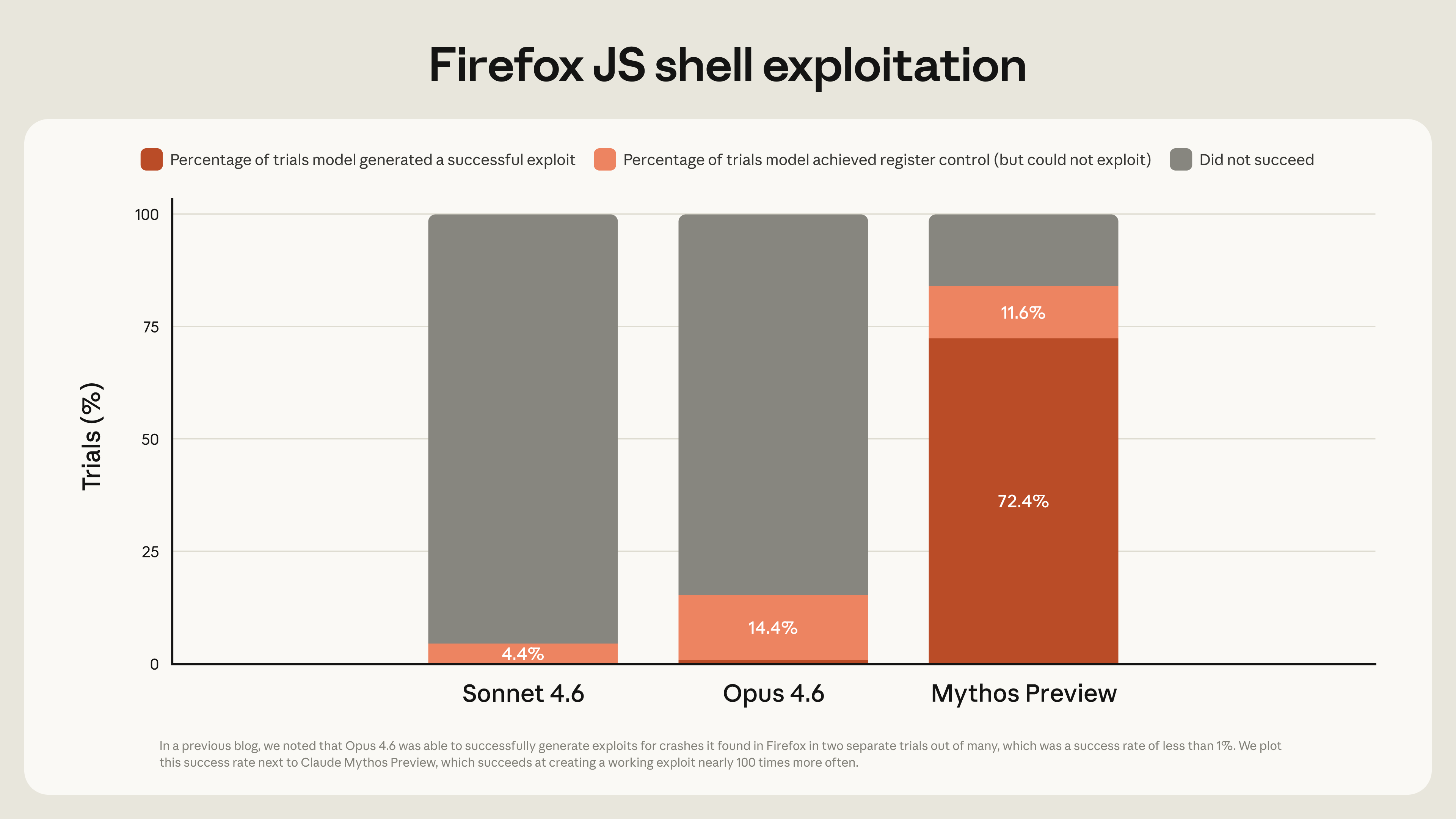
No, Opus has found a lot and 112 vulnerabilities were reported to Firefox alone by Opus [0]. But Mythos is uniquely capable of exploiting vulnerabilities, not just finding them.


Sad if true, they should have known that was a long shot, it's extremely well known that the number of postdoc and tenure track openings in any given year is far exceeded by the number of PhD grads each year.
reply