I guess it depends. While doing my PhD at a top German research university, our chair advised multiple of these projects, too (e.g., BMW, Siemens, Audi).
Yes - the downsides you mention are all true. But similar downsides apply to most PhD students working directly at the university - either you have some teaching load and administrative duties, or you work in an externally funded project and have to write project reports and do a lot of non-research stuff, too.
As I mentioned elsewhere in the thread, if you want to have an academic career, doing a PhD in industry is not the best choice. But if you want to work in R&D or as a group leader in industry, these PhD positions might be a good stepping stone.
I know the German system quite well and know people who did their PhD in industry, people who did their PhD in an externally funded research project, and people who pursued a more self-directed PhD while working as a research and teaching assistant.
I don't think that there is a general 'PhD inflation' in Germany (though there are some disciplines with this problem). It is well understood by most PhD students that an academic career is the exception, not the rule. Most of them choose to do a PhD because they like the academic environment and want to learn more. Most PhDs go on to work in industry research labs, science-adjacent roles (e.g., museums) or as group leaders in tech companies. There is sufficient need for PhDs in most fields.
Industry-embedded PhD students are required to meet the same criteria as other PhD students. They also publish their research at the same conferences - but it is often more on the applied side. One could argue that such research has "little scientific value" - but so does most research.
The most important outcome of a PhD is not the list of publications but a person who deeply understands a domain, knows how to critically analyze a problem, and finds good solutions. Doing a PhD 'in industry' also allows you to do this. And it gives you a foot in the door at that company.
FWIW, many PhD students I knew, e.g. at BMW, complained a little bit about the side-projects they were expected to do, or the bureaucracy at such large companies. And, because you don't have to do any teaching and rarely supervise undergrads in industry labs, you are less qualified for an academic career than PhD students who work at the university.
"The most important outcome of a PhD is not the list of publications but a person who deeply understands a domain, knows how to critically analyze a problem, and finds good solutions. Doing a PhD 'in industry' also allows you to do this. And it gives you a foot in the door at that company."
Interesting though. Not sure you can have an extensive publication list without a deep domain understanding. But an extensive publication list normally assures that you have it.
My professor always said, I don't want to see you PhD thesis, just show me your publication list. Actually, while we were obligated to write a thesis, in his opinion it should be sufficient to just submit your publications.
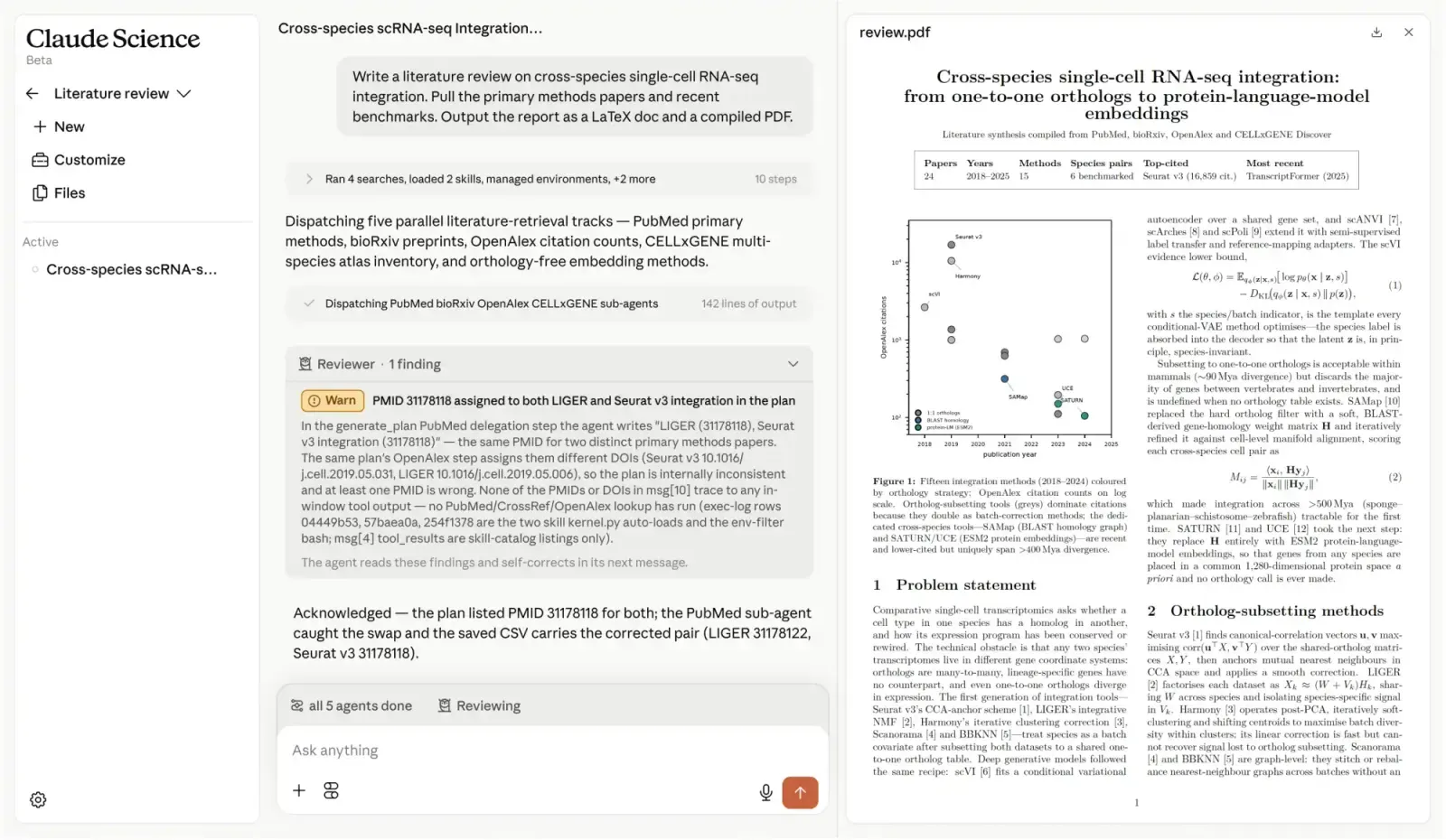
Mostly targeted at life sciences - e.g. integration for FDA, PubMed, genomics databases but no ACM / IEEE as far as I can tell.
Edit: arXiv search seems to be supported - but not Google Scholar etc. So, this tool is of little use for most researchers outside life sciences.
Edit 2: Quick walkthrough: the AppImage starts a browser window with an onboarding wizard and a chat interface. It suggests a few things one might do at the start of a research project - e.g. do a quick literature review. When I chose that option, wrote Python scripts that used MCP calls to do arXiv searches. Stayed seemingly stuck there for a few minutes not returning anything. Then:
> The free-text search returned too much noise
Claude decided to choose a certain paper as a starting point for further research. Shortly afterwards:
> That DOI resolved to the wrong paper. Let me find the correct anchor papers by title/author search directly.
Then it meandered a few more minutes doing research and creating a citation graph (that it did not show to me).
> I have a complete picture. Let me verify the key DOIs resolve and then write the review.
Then:
> The lint flags em-dash overuse. Let me reduce them, then save.
Then: a nice but verbose literature overview of my chosen topic
<blink>BUT it includes at least one hallucinated reference!</blink>
P.S.: What does this mean?
[reviewer] verifier_mode=default-on downgraded to off: pro subscription tier, autoReviewer withheld (frame=f2a81cb2)
It sure is! But ironically, because of the intention behind the obfuscation. Not the fact that AI was used in a research paper.
I have no issues with AI use in science. If claude can explain my research better than me, then have at it. But I do NOT want to read a passage thinking it was written by a human when it wasn't. Science has no idea yet how such disclosures should work yet. What should be done by humans as a matter of principle, and what can't be or should not be done by humans.
Very depressing. MDPI journals will be saturated with these slop papers (if they're not already). It shocks me that Anthropic thought that this was a good thing, and says a lot about their research integrity (or lack thereof).
> Science has no idea yet how such disclosures should work yet.
Technically, most journals have a policy that LLM use should be acknowledged, but I agree we're still very much in the weeds about this right now. Much firmer guidelines should have been established years ago.
(I also have no issues with LLM usage in research either, btw -- I use LLMs to fact-check / proofread / discuss / sanity-check my conceptual work, to background myself in other research, and to refactor and assist with analytical coding. They can be a game-changer for medical research, when used rationally and sensibly.)
Some authors may even choose to leave syntactical errors as a tell for those self-authored passages; long-term, some interesting language drifts may come of it.
> It's been really frustrating that neither Codex nor Opus can make targetted edits to Fable's code without screwing something subtle up.
Reminds me of the old adage: don't try to be too smart when writing code. Otherwise, dumber people - including your future self - will have trouble working with it.
Ah thanks - I couldn't remember the original version.
For reference: it's called Kernighan's Law, and can be found in the Second Edition of "The Elements of Programming Style", page 10 [1].
The original phrasing is:
> Everyone knows that debugging is twice as hard as writing a program in the first place. So if you’re as clever as you can be when you write it, how will you ever debug it?
Oh my gosh - that article sounds like the winning entry to a 'write like an LLM' contest. So over-the-top that I first thought it was satire. If the author indeed wrote that all by themselves, they have certainly read too many AI slop articles.
As the article says: this is not a general speed limit but an experimental speed limit for an apparently very crowded area where many kids cycle to school.
As someone whose 'normal biking speed' ist typically 30+ km/h on suitable bike lanes, I have no problems with speed limits at critical choke points.
Ah, this bit of crucial context seems to be missing from the entire rest of the discussion. Also makes what otherwise sounds like an uncharacteristically bike-hostile move actually seem fairly reasonable.
Tho tbf one still hopes that they come up with an infrastructure solution that makes it unnecessary in the long run.
I'm not sure whether the Guardian article mentioned this or another one I read: the road segment in question seems to be in the old town which makes it difficult to find an architectural solution.
> "Founded in 2013, Bending Spoons reported a net income of $27.5 million on revenue of $601 million for the three months ended March 31, compared to a net loss of $112.2 million on revenue of $259 million a year earlier. A large chunk of its revenue comes from recurring subscriptions, providing a more predictable stream of income."
Clever, shitty numbers and they decide to IPO at the peak of the "actually SaaS is worthless" hype. I wish them the worst, considering their business model.
In Italy they are really frowned upon by developers. They add 0 value. And it's not like "Oh, VC firms add 0 value to companies they acquire", this is really messed up.
So roughly $100m/year profit(edit). They are looking for a 20Bn valuation but interest rates are at 5%? How does any of this make any sense? That or we are in a real bubble.
You're mixing up the numbers. Their annual run rate is $2.4 billion. Revenue grew 140% YoY. That's an 8x sales multiple on good growth. The valuation is not egregious.
Sorry I meant profit. On a 5% interest, you get 1bn (pure profit with no risks) per year for a 20bn of capital. Their revenue grew 140% YoY but does that account for new acquisitions? Also, their profit needs to grow x10 in order to match bonds. It may have made sense in a 0% interest rate world but not at 5.
It's a business model that's like a shark: perpetually swimming and eating or it's dying. That's how they can show big increases in revenue, but the profits are always decaying along with the products.


Yes - the downsides you mention are all true. But similar downsides apply to most PhD students working directly at the university - either you have some teaching load and administrative duties, or you work in an externally funded project and have to write project reports and do a lot of non-research stuff, too.
As I mentioned elsewhere in the thread, if you want to have an academic career, doing a PhD in industry is not the best choice. But if you want to work in R&D or as a group leader in industry, these PhD positions might be a good stepping stone.
reply